

Ask a room of tutors what parents care about, and most will give you some version of the same answer: results. Parents care about grades. They care about whether their child is improving. They care about exam scores and progress and whether the tutoring is working.
And they're not wrong, exactly. Results matter. No parent is indifferent to whether their child is actually learning. But the assumption that results are the primary driver of parent satisfaction — and therefore of client retention — is one of the most persistent and costly misconceptions in private tutoring.
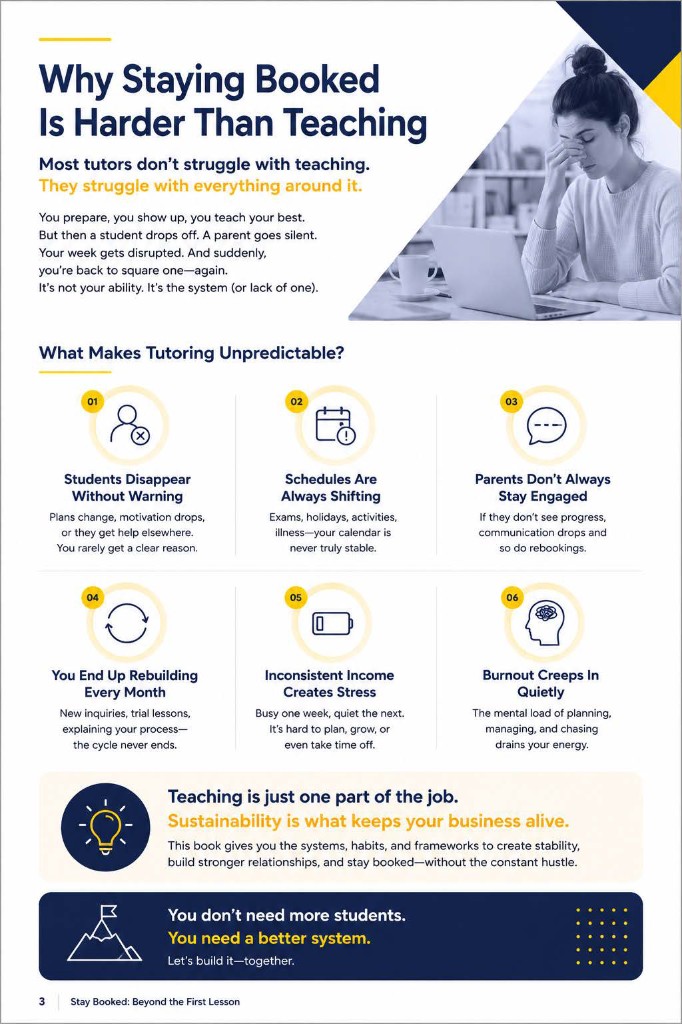
The tutors who are consistently busy, consistently recommended, and consistently retained are not necessarily the ones with the most impressive academic records. They are the ones who understand that teaching the student is only part of what families are paying for.
The Measurement Problem
One reason tutors over-index on results is that results feel measurable. A grade goes up; the tutoring is working. A grade stays flat; something must be wrong. This seems logical. But in practice, academic results are among the worst short-term indicators of tutoring quality — and they are almost never the primary reason a parent continues or ends a tutoring relationship.
Academic improvement is slow, non-linear, and easily contaminated by other variables. A student who improves might have done so regardless. A student who doesn't improve in the first six weeks might be on the verge of a breakthrough. Parents generally understand this, at least intellectually. What they struggle with is uncertainty — the feeling of not knowing what's happening and having no way to find out.
That uncertainty is what drives dissatisfaction. Not results.
The Feedback Loop Failure
Most tutors do not offer regular, unsolicited feedback to parents. Many offer almost none at all. Sessions happen, time passes, and parents are left to infer progress from their child's mood or test scores — neither of which is a reliable guide.
This is not usually intentional negligence. Tutors are often simply unaware of how the parent experience feels from the outside. They are focused on the teaching, on the student's needs, on planning the next session. The parent's experience barely enters the frame.
But from the parent's perspective, the silence is deafening. A tutor who never volunteers information starts to feel like a black box. The parent doesn't know what's being covered, whether the tutor has noticed their child's specific difficulties, or what the plan is for the weeks ahead. Eventually, this uncertainty starts to feel like something is being hidden — even when nothing is.
The fix is simple. Not elaborate — simple. A short message after each session. Two or three sentences covering what was worked on, how the student engaged, and what comes next. That's all. Done consistently, it transforms the parent experience from anxious and passive to informed and engaged. It takes the tutor three minutes. It changes everything.
The Professionalism Gap
Another area where tutors consistently lose parents — often without realising it — is professionalism. Not in the grand sense of qualifications and credentials, but in the small operational details of how they run their work.
Starting sessions on time. Responding to messages within a reasonable window. Handling rescheduling graciously rather than grudgingly. Following through on things they've said they'll do — sending resources, checking in, flagging concerns. These are not exciting skills. They are the administrative basics of running a client-facing service. And their absence is noticed far more sharply than their presence.
A tutor who is brilliant in lessons but slow to reply and inconsistent about timekeeping will feel — from the parent's perspective — less reliable than a slightly less brilliant tutor who is punctual and responsive. This seems unfair. It is, however, true. Parents form their impression of a tutor's competence partly through these operational signals. If a tutor can't be relied on to start on time or answer a simple question, what does that suggest about how they run their sessions?
Rethinking the Role
The tutors who consistently get this right have internalized something that the others haven't: the parent is also their client. Not instead of the student — alongside them. The student is in the room. The parent is the one writing the cheque, making the decision to continue, and referring their friends.
This means the tutoring relationship has two audiences. The lesson is for the student. The communication is for the parent. Both need to be attended to, and attending to one at the expense of the other is a losing strategy.
Some tutors resist this framing. They became tutors because they love teaching, not because they wanted to manage client relationships. That's understandable. But the market has its own logic. A tutor who refuses to think about the parent experience will find their diary quietly emptying, for reasons they may never fully understand.
A Practical Reframe
The most useful thing any tutor can do is spend ten minutes imagining the experience from the parent's point of view. What does the parent know about how the sessions are going? What have they heard from their child? What have they heard from the tutor? How confident do they feel?
If the honest answer is "not very," that is useful information. It points directly to where the work needs to happen — not better lesson planning, not additional qualifications, but better communication and a more consistent client experience.
Parents are not asking for much. They want to feel informed. They want to feel confident. They want to believe that their child is in good hands and that if anything changes, they'll be the first to know.
Meeting those expectations is not complicated. But it does require tutors to look up from the lesson and remember that someone else is watching — from outside the room, quietly deciding whether to stay.